“Let us go to the villages and stay the night.
Let us wake up at dawn and see whether the grapevines have sprouted and blossomed, whether the pomegranate trees have flowered.
There, I shall offer you my love.”
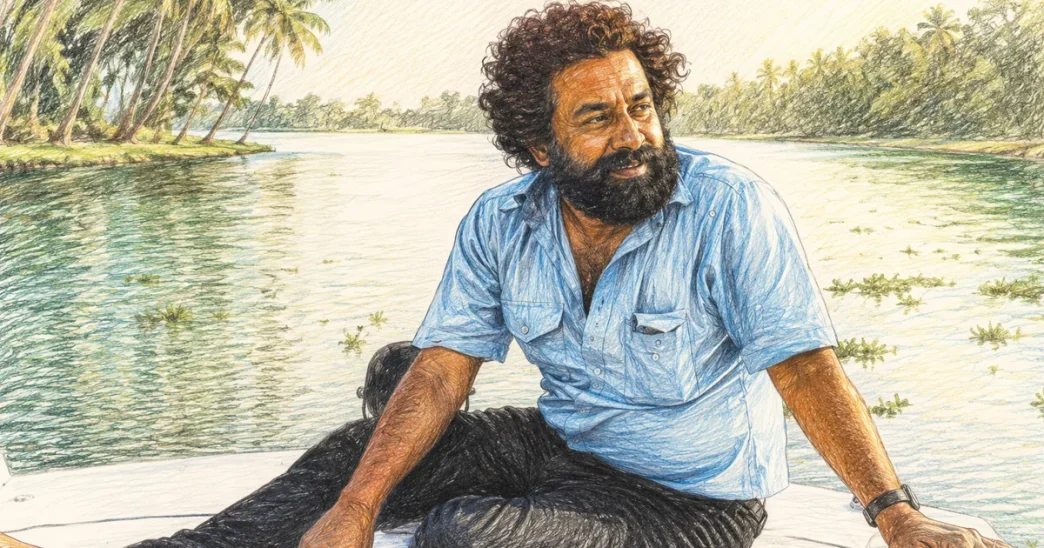
Few have descended into the subtle depths of the human mind and brought before us what seems unbelievable, while giving each character in a story its own distinct importance, as Padmarajan did. He was undoubtedly one of the most powerful storytellers Malayalam literature has ever known. Even today, his films remain etched in the hearts of audiences. The characters that filled his cinema were often drawn from his village and from the lives he had encountered. When he brought to life a Gandharvan—cursed and sent from the celestial world we had only heard about in grandmother’s tales—we too began to believe in that reality. In many ways, Padmarajan himself was a Gandharvan. Though he lived only until the age of forty-six, he carved unforgettable seasons of creative brilliance in Malayalam cinema and literature.
Padmarajan journeyed through uniquely creative paths. He was an artist who portrayed love and human emotions on screen with extraordinary beauty. His full name was P. Padmarajan Pillai. He was born on May 23, 1946, in Muthukulam, Alappuzha district, as the sixth son of Ananthapadmanabha Pillai and Devakiyamma of Njavarakkal. His wife was Radhalakshmi, and his children are Ananthapadmanabhan and Madhavikutty. 
After completing his primary education in Muthukulam, he earned a degree in Chemistry from Mahatma Gandhi University College, Thiruvananthapuram, in 1963. During this period, he also studied Sanskrit under Cheppad Achuthavaryar. While in college, his attention turned toward writing stories. His first published work was “Lola Miss Ford,” about an American girl, which appeared in Kaumudi Weekly. In 1965, he joined All India Radio, Thrissur, as an announcer and continued there until 1986. With his growing involvement in cinema, he voluntarily resigned from his position and later settled in Poojappura, Thiruvananthapuram.
He was renowned as a director, screenwriter, and novelist. Some of his most memorable films include Oridathoru Phayalvaan (1981), Arappatta Kettiya Gramathil (1986), Namukku
Parkkan Munthirithoppukal (1986), Thoovanathumbikal (1987), and Moonnam Pakkam (1988). His final film was Njan Gandharvan (1991).
Among his notable novels are Prathimayum Rajakumariyum, Rathinirvedam, Manjukalam Notta Kuthira, Rithubhedangalude Parithoshikam, Udakapola, and Nakshathrangale Kaaval—works that deeply explored the realities of life.
He presented new dimensions of love and life through films like Thoovanathumbikal, portrayed same-sex affection without vulgarity in Deshadanakkili Karayarilla, and depicted the romantic intensity of vineyards in Namukku Parkkan Munthirithoppukal. There are countless such screenplays that bear his unique signature.
His novel Nakshathrangale Kaaval (1971) gained widespread acclaim and won the Kerala Sahitya Akademi Award and the Kungumam Award that year. Later works include Vadakakkoru Hridayam, Itha Ivide Vare, and Shavavahanangalum Thedi. Novels such as Udakapola, Manjukalam Notta Kuthira, and Prathimayum Rajakumariyum were written after he became prominent in cinema. Other celebrated works include Peruvazhiyambalam and Rathinirvedam.
His first screenplay, Prayanam (1975), was directed by Bharathan and marked the beginning of the acclaimed Bharathan–Padmarajan partnership, which became central to what was known as “middle cinema” in Malayalam—positioned between parallel and commercial cinema. Together, they portrayed sexuality with sensitivity and dignity, never descending into vulgarity.
Padmarajan wrote screenplays for 36 films and directed 18. Through the cinematic adaptation of Peruvazhiyambalam, he made his directorial debut. He received numerous national and international honors, including the Kerala Sahitya Akademi Award and prestigious film awards. In addition to 15 novels and 35 screenplays, he wrote many short stories.
On January 24, 1991, while in Kozhikode to attend the preview of Njan Gandharvan, Padmarajan was found dead in his hotel room.
Thirty-five years have passed since the Gandharvan of stories fluttered away like a butterfly. Flowers of remembrance to our beloved Pappettan.